
James M. Shuart Stadium at Hofstra University
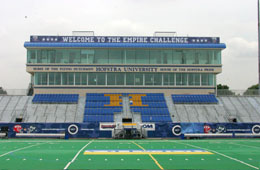
In February 2002, Hofstra University President Stuart Rabinowitz announced that the University's 13,000-seat stadium — home to Hofstra's football, lacrosse and field hockey programs — would carry the name James M. Shuart Stadium at Hofstra University. The facility was formally dedicated on August 29, 2002.
Rabinowitz noted that during Dr. James M. Shuart's 25 remarkable years as president, Hofstra grew from a respected regional institution into an internationally recognized university. He explained that Shuart's background as a student athlete and his support of the athletic program made the naming especially fitting, and that it would convey admiration and respect for James Shuart to the thousands of people who use the stadium each year.
President Emeritus Dr. James M. Shuart said that many remarkable dreams become reality at Hofstra through the dedication and hard work of the University's trustees, administrators and faculty, and that he worked closely with colleagues on projects such as the stadium. He described the marvelous stadium as a first-class venue for students, alumni, visitors and friends, and one of the top on-campus intercollegiate sports facilities — indoor or outdoor — in the New York metropolitan area, adding that he was truly honored by the Board of Trustees' decision.
Renovation & Expansion
James M. Shuart Stadium, then known as Hofstra Stadium, benefited from a major renovation and expansion plan completed in the fall of 1996, making it one of the premier facilities in the nation. The $9 million project included:
- Expansion of seating capacity from 7,000 to 15,000
- A network-quality lighting system for television broadcasts
- An Athletic Department office building with a press level and a club suite level
- Two entrance plazas on the south and west sides of the Stadium
- A facade around the outside of the Stadium
- Additional parking and landscaping
- A pavilion in the southeast corner of the Stadium
- Concession and souvenir areas
- Two locker rooms
- A state-of-the-art scoreboard in the south end zone and the reinstallation of a scoreboard in the north end zone
James M. Shuart Stadium is the largest outdoor sports and entertainment complex on Long Island.
History & Events at the Stadium
Then-President Shuart stated that the renovation and expansion provided students, alumni, visitors and friends with a first-class facility in which to practice, play or watch their favorite sport, and that it ranks among the top on-campus intercollegiate sports facilities — indoor or outdoor — in the New York metropolitan area.
Opened in 1963, Shuart Stadium has served as the site for NCAA Championships, Nassau County and New York State High School Championships in football and lacrosse, world championships in men's and women's lacrosse, professional soccer, commencement exercises and cultural events. In 1968, Hofstra Stadium became the third college facility in the nation to install an artificial playing surface, following the University of Houston (The Astrodome) and Indiana State University (Memorial Stadium).
In recent years Shuart Stadium has become a focal point of the Long Island sports scene, serving as home of the NCAA Division I Men's Lacrosse Championship Quarterfinals, conference championships, the Outback Steakhouse Long Island All-Star Football Game, the Hero's Bowl, the Long Island Lizards of Major League Lacrosse, various Long Island high school and New York state championship games and the 1999 Empire State Games. The Stadium also served as a home for the Long Island Rough Riders of professional soccer's A-League.
The two largest crowds in Hofstra Stadium history occurred during the hosting of the NCAA Lacrosse Quarterfinals. A crowd of 12,292 — an NCAA men's lacrosse championship quarterfinal record and the largest-ever lacrosse crowd on Long Island — witnessed the 1999 NCAA quarterfinals featuring Hofstra versus Johns Hopkins and Duke versus Georgetown, and 10,510 fans attended the 2001 quarterfinals that featured Hofstra against Syracuse.
In addition to the recent renovations, within the past decade the Stadium has received a new balsam turf playing surface, several sections of new chair-back seating, a new sound system and the $3.8 million Joseph M. Margiotta Field House in the south end zone.
Frequently Asked Questions
2019 UnitedHealthcare Empire Challenge
James M. Shuart Stadium at Hofstra University — Final Score: LI 44, NYC 20.
The game will air on CBS Sports Network on 6/29 at 3:00PM.
2019 Gameday PhotosFollow the Empire Challenge
Keep up with the latest news and updates from the Empire Challenge.
Tweets by @EmpireChallengeOfficial Game Sponsors

© 2014 Empire Challenge / BEF